Start With Contract Scope
A fiber laser service contract cost review should start with the document, not with a public price range. The useful question is what the shop is buying, what is excluded, and where the annualized cost belongs in the quote model.
Use this scope ledger before sending the value to the hourly-rate model:
| Scope line | What to capture | Strongest record | Modeling check |
|---|---|---|---|
| Contract coverage | Preventive visits, remote support, labor coverage, parts coverage, response terms, and renewal period. | Signed service agreement, proposal, renewal quote, or warranty document. | Coverage is copied from the actual document instead of assumed. |
| Exclusions | Travel, expedited service, consumables, optics, filters, software, abuse, operator error, and out-of-hours work. | Exclusion section, quote notes, vendor email, and service-ticket history. | Excluded items have a separate destination in the model. |
| Planned maintenance | Scheduled work, inspection checklist, calibration tasks, cleaning, chiller care, exhaust care, and record date. | OEM maintenance schedule, service proposal, and shop maintenance logs. | Planned work does not duplicate a covered contract visit. |
| Consumables | Nozzles, protective windows, lenses, filters, coolant items, wear parts, and spare stock policy. | Supplier invoices, storeroom records, service tickets, and machine logs. | Included, excluded, and partly covered items stay in separate rows. |
| Downtime treatment | Production stoppage, outsourced recovery, schedule recovery, expedite cost, and capacity risk. | Machine logs, job schedule records, late-order review, and outsourcing invoices. | Downtime is placed once as cost, risk note, capacity input, or ROI scenario. |
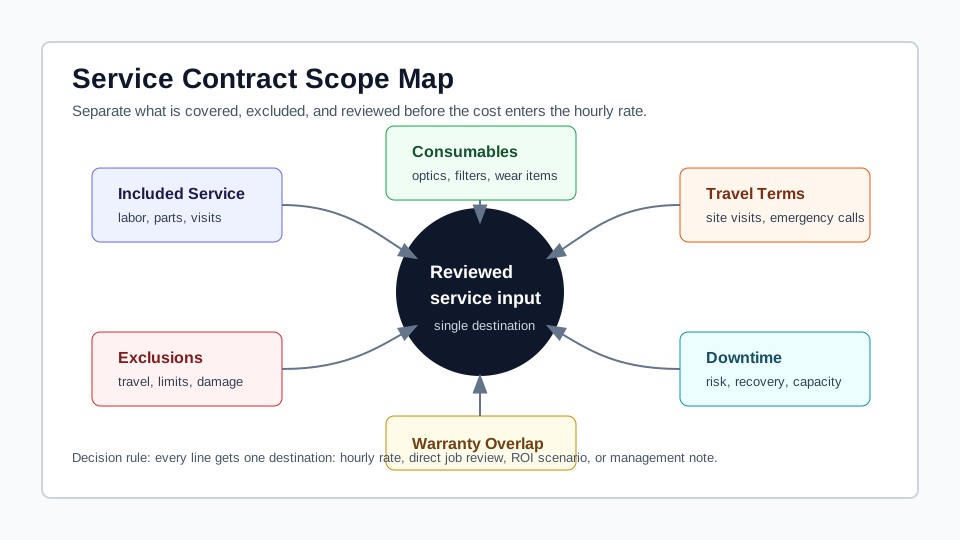
Service scope, exclusions, consumables, travel, downtime, and warranty overlap should be visible before the cost is annualized.
Annualize The Maintenance Input
Convert recurring maintenance and service items into one reviewed annual input before sending it to the hourly-rate model:
Annual service input = annualized contract cost + excluded planned-work allowance + annualized consumables allowance + emergency repair allowance + travel allowance + downtime allowance or productive-hour adjustment
Then convert the recurring annual input into the cost-floor unit used by the shop:
Maintenance cost per productive hour = annual maintenance input / annual productive machine hours
If the cost is normal and recurring, it usually belongs in the shop hourly-rate model. If the cost belongs to one unusual job, one customer requirement, or one extraordinary repair event, keep it outside the blended shop rate until the quote policy says where it belongs.
No line should enter twice. If the service contract includes a preventive visit, do not also add the same visit as a separate planned-maintenance line. If the hourly rate already includes a maintenance accrual, do not add the same accrual again as a direct quote surcharge.
Keep The Buckets Separate
Each maintenance bucket should stay separate until the estimator chooses a destination.
| Bucket | Include when | Keep separate from | Where it flows |
|---|---|---|---|
| Service contract | A vendor agreement covers defined labor, parts, visits, or support access. | Consumables, travel, emergency work, and excluded parts unless the contract says otherwise. | Operating cost per hour guide |
| Planned maintenance | The shop schedules recurring machine care, inspections, cleaning, calibration, or vendor visits. | Unplanned repairs and production downtime. | Hourly rate builder |
| Consumables and optics | Wear items are consumed by production or machine operation. | Blank material, assist gas, and one-off damaged parts. | Laser quote workflow or hourly-rate model |
| Chiller and exhaust upkeep | Support equipment is required for the laser cell and has its own service pattern. | Laser-source service and facility overhead unless bundled by policy. | Energy calculator and hourly-rate review |
| Travel and response terms | The vendor charges or limits site visits, travel, response windows, or out-of-hours support. | Guaranteed uptime claims unless they are written in the contract. | Contract review note or maintenance accrual |
| Downtime and recovery | Machine stoppage creates outsourcing, rescheduling, late delivery, or capacity cost. | Normal maintenance work that does not stop production. | Risk review, capacity review, or ROI scenario input |
Trace The Annualization
The trace below is arithmetic only. Replace each value with the actual service agreement, warranty document, vendor quote, invoice, maintenance log, and accounting policy before using the result in a quote.
| Line | Illustrative input | Review note |
|---|---|---|
| Annualized contract cost | Contract proposal amount for the policy period | Confirm labor, parts, visit count, response terms, renewal date, and warranty overlap. |
| Excluded planned work | Planned tasks not covered by the agreement | Do not add covered preventive visits again. |
| Consumables allowance | Nozzles, optics, filters, coolant items, and wear parts not included in the contract | Separate production consumables from service parts. |
| Emergency repair and travel | Reviewed reserve for unplanned service, travel, or out-of-hours work | Use service tickets and vendor terms; do not infer a universal reserve. |
| Downtime treatment | Productive-hour adjustment, risk note, recovery line, or ROI scenario | Pick one destination before the cost moves into the quote model. |
| Annual maintenance input | Sum of the reviewed annual lines | This is the value that can move into the hourly-rate model. |
| Productive-hour conversion | Annual maintenance input / annual productive machine hours | Use the same productive-hour policy as the hourly-rate builder. |
This trace intentionally avoids a public maintenance price. The point is to preserve the relationship between contract scope, exclusions, annualization, and hourly-rate transfer.
Run The Double-Count Gate
Maintenance cost often appears in more than one place: service proposal, hourly rate, consumable line, overhead pool, emergency reserve, and direct job surcharge. Use this gate before the cost enters a quote:
- Mark the source document for each line.
- Mark whether labor is included, excluded, limited, or conditional.
- Mark whether parts are included, excluded, limited, or conditional.
- Mark whether travel is included, excluded, limited, or conditional.
- Mark whether downtime is costed, noted as risk, placed in productive hours, or modeled in ROI.
- Mark the destination: hourly rate, overhead, direct job line, ROI scenario, or management review.
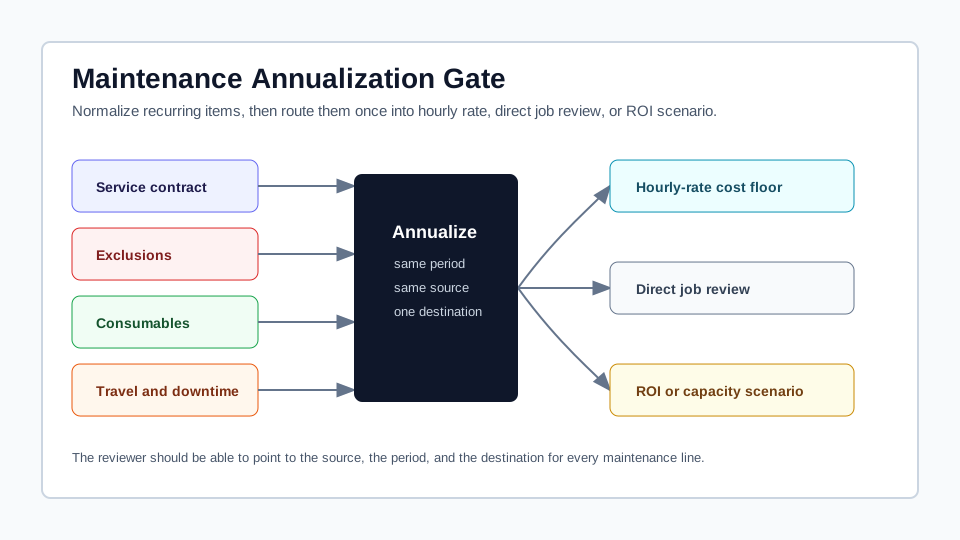
The annualization gate prevents a contract line, excluded item, or downtime allowance from entering the quote model in two places.
Check Warranty And Renewal Timing
Warranty overlap can make a service contract look cleaner than it is. Record whether the machine is under base warranty, extended warranty, vendor service agreement, third-party service, or internal maintenance policy. Then record when each coverage period starts and ends.
The renewal check should answer:
- Does the current quote include the first coverage period only?
- Does support change after installation, training, or warranty transition?
- Are remote support, on-site labor, parts, travel, and consumables treated differently?
- Are response windows written obligations or sales notes?
- Is the renewal assumption approved before it enters the hourly rate?
Do not interpret contract legal terms from this page. Copy the fields, route unclear language to the vendor or advisor, and keep the quote model honest about what has and has not been confirmed.
Place Downtime Once
Downtime is not always a maintenance cost. Sometimes it is a production-capacity risk, sometimes it creates outsourced recovery cost, and sometimes it belongs in a purchase or ROI scenario.
| Downtime destination | Use when | Review risk |
|---|---|---|
| Hourly-rate allowance | Recurring downtime is part of the shop's productive-hour policy. | Available hours and productive hours must use the same definitions. |
| Emergency reserve | The shop wants a reviewed allowance for unplanned service events. | The allowance must not duplicate covered contract labor or parts. |
| Direct recovery line | A specific job needs outsourced backup, expedite freight, or special support. | The customer quote should show why this job is different. |
| ROI scenario | The purchase decision depends on uptime, support access, or replacement capacity. | Do not imply a response-time or uptime guarantee unless it is written in the contract. |
Move The Clean Value Into The Quote Workflow
Use the maintenance input in this order:
- Capture contract scope and exclusions from the service proposal or warranty document.
- Separate planned maintenance, consumables, optics, filters, chiller, exhaust, travel, and emergency repairs.
- Decide whether downtime is a cost input, risk note, capacity input, or ROI scenario.
- Annualize recurring items using the same policy period as the hourly-rate model.
- Compare the treatment with the hourly cost structure guide.
- Send the reviewed value to the hourly rate builder.
- Carry the hourly rate into the laser cutting calculator.
- Use the power reference and energy calculator when service scope changes auxiliary equipment assumptions.
No public maintenance price benchmark is assumed. Buyer interest proves only that the checklist is useful; it does not prove the right maintenance budget for a shop, machine, warranty state, location, or vendor relationship.
What Belongs In A Service Contract Cost Review?
Record contract coverage, preventive schedule, included labor, included parts, excluded parts, travel rules, response terms, warranty overlap, renewal timing, consumables, emergency repair policy, downtime treatment, and the destination inside the quote model.
Where Does The Cost Go In The Hourly Rate?
Recurring reviewed contract cost usually becomes part of the annual maintenance input, then divides by annual productive machine hours in the hourly-rate model. Unusual or job-specific service cost should be reviewed separately before it becomes a direct quote line.
Keep Contract Interpretation Outside The Model
LaserCalc Pro can organize the maintenance ledger and send clean inputs into calculators. It cannot interpret contracts, guarantee response time, predict uptime, or publish a universal service price. Use contract documents, vendor confirmation, shop logs, invoices, machine records, and reviewed accounting policy as the source of truth.